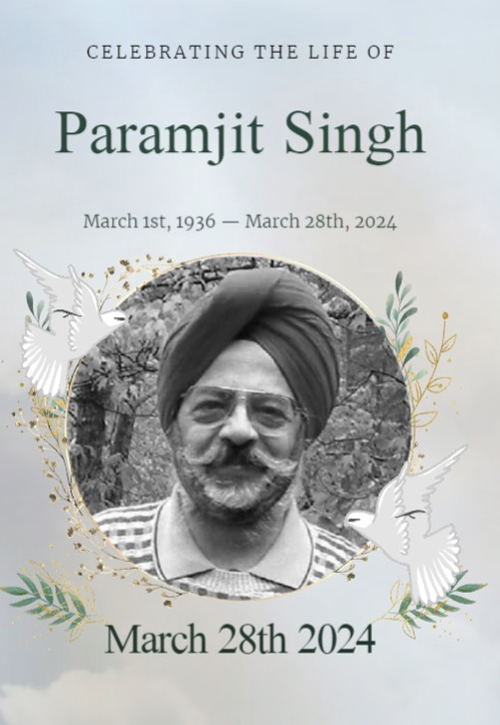
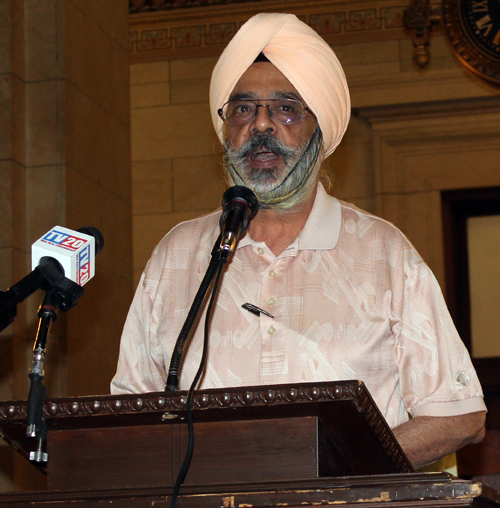
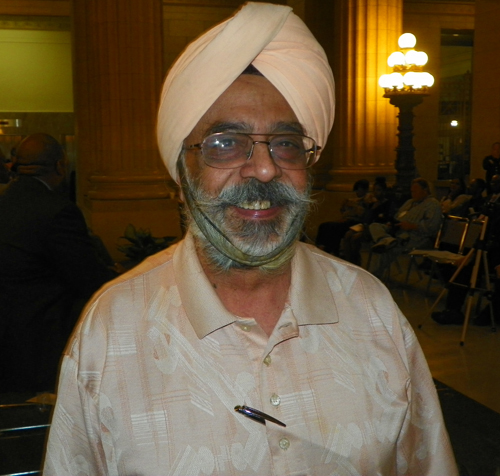
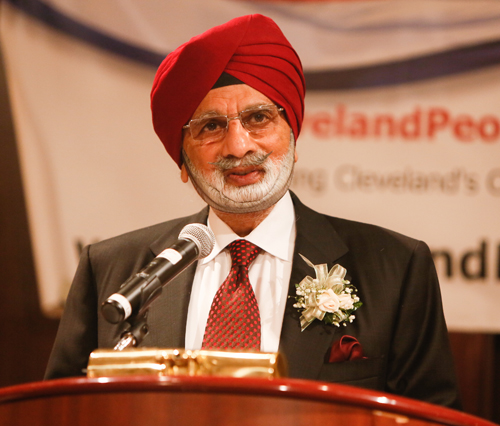
Paramjit Singh was a Community Leader of the Asian Indian Community since he first landed in Cleveland in June of 1962. Being a Sikh, he has dedicated his life to doing good works and serving the needy.
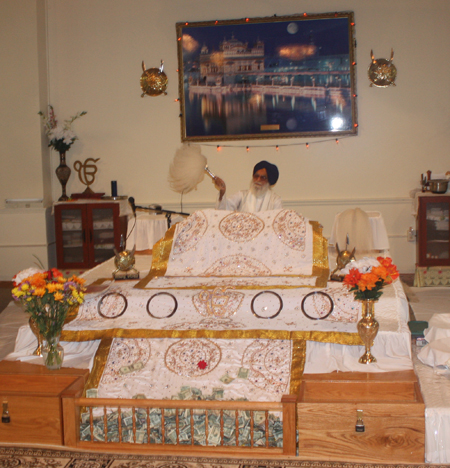
To honor the life of Paramjit Singh, a memorial service was held at Gurdwara Guru Nanak Foundation in Richfield Ohio
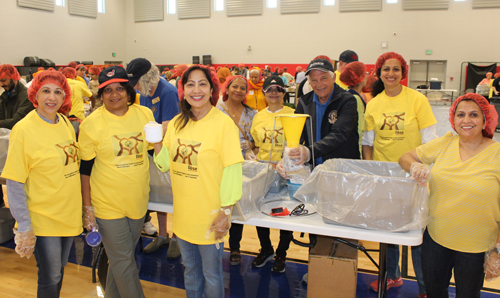
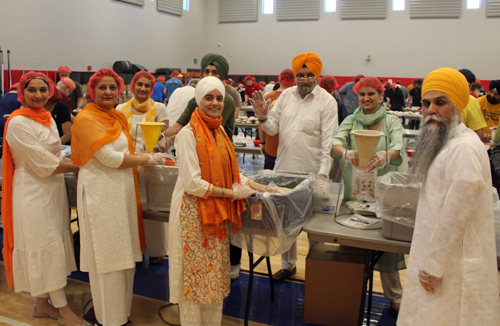
Indian and Sikh volunteers help provide 120,000 meals for the world's hungry
Richfield Ohio Mayor Mike Wheeler was inspired by a recent event at the Jain Temple in Richfield that prepared over 10,000 meals for those in need around the world. He worked with Ramesh Shah to get sponsors and put a plan together with the Rise Against Hunger organization to gather the community and try to make 120,000 meals for those in need all over the world. Revere High School in Richfield was full with over 500 community members including Indian groups such as Project Seva and members of the Sikh community from Gurdwara Guru Nanak Foundation.
The BBC News posted a terrific article titled: Viewpoint: Why Sikhs celebrate kindness by Jasreen Mayal Khanna, the author of Seva: Sikh Secrets on How to Be Good in the Real World.
It begins, "Founded some 500 years ago in what is now India's Punjab region, Sikhism is the world's fifth-largest religion. But what makes its members habitual do-gooders? Author Jasreen Mayal Khanna writes on the tradition of selfless service ingrained in the community."
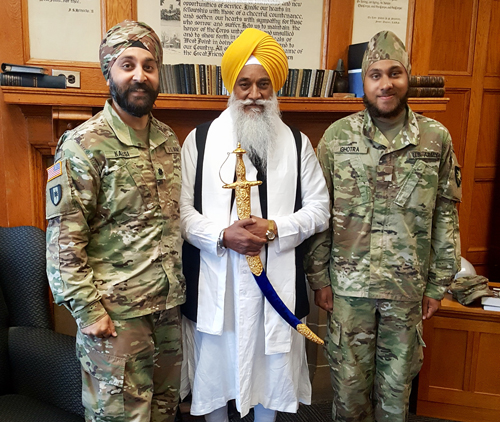
Sikh Spiritual Leader Visit to the U.S. Military Academy at West Point
Giani Gurbachan Singh, the current Jathedar of the Akal Takhat and the spiritual leader of the Sikh religion, visited the United States Military Academy at West Point on September 11th, the first visit ever of a Sikh spiritual leader to any U.S. military installation.
Sikhs have faced hate crimes, bullying and job discrimination in the wake of 9/11.
As the founder of Sikh American Veteran’s Alliance (SAVA), LTC Kalsi states, “This visit helps to push back against discrimination by promoting Sikh military service in one of our nation’s oldest and most revered institutions.”
US Vice President Mike Pence applauds Sikhs’ contribution
US Vice President Mike Pence has lauded the contribution of Sikhs in America and asked them to continue to give back by serving in the military and public offices at local, state and federal levels. “Sikh Community and its issues are always close to my heart and I always admire the contribution of Sikhs in Indiana and across the US,” he told a Sikh delegation in Indianapolis. During the meeting with the Sikhs Political Action Committee (SikhsPAC) led by Gurinder Singh Khalsa, Pence said that he was fully aware of Sikh awareness issues since his days as Governor, a SikhsPAC media release said.
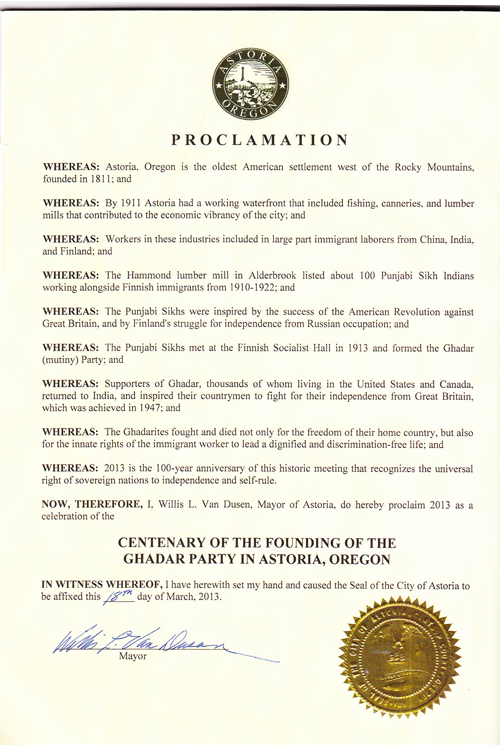
Ghadar Party Centenary in Astoria Oregon Proclamation
Thanks to Ambassador Paramjit Singh for sending us a copy of this historic document.
Dr. Marwah on getting the first Indian-American elected to U.S. Congress
Sikhs in US Military
105 members of the U.S. House of Representatives sent a letter to Defense Secretary Chuck Hagel in support of equal opportunity for Sikhs who wish to serve in the U.S. Armed Forces with their articles of faith intact.
A similar letter is working its way through the U.S. Senate.
If you support efforts to end discrimination by the largest employer in the United States—the Department of Defense—please click here to sign a petition to your U.S. Senators today.
The First Amendment to the U.S. Constitution guarantees Americans the freedom “to petition the government for a redress of grievances.” Let’s exercise this right in support of our civil rights.
Another First for Sikhs
Congratualtions to Dr. Gurdas Singh Dass who became the first Sikh veternarian to be on the American Veterinary Medical Board and its President in Ohio and the US.
VICTORY! 10 Months After Oak Creek, FBI Group Votes to Track Sikh Hate Crimes
From The Sikh Coalition:
June 5, 2013 (Washington, DC) – An advisory policy board of the Federal Bureau of Investigation (FBI) voted this afternoon to revise its hate crime statistics so that hate crimes are tracked against Sikhs, Hindus, and Arabs.
The board voted to create new religion tracking categories based on religious groups enumerated in Pew Forum studies and the last edition of the U.S. Census Bureau’s Statistical Abstract of the United States, which includes Sikhs. The new changes are expected to be implemented by 2015.
The highly anticipated decision comes more than two years after the Sikh Coalition first requested that the agency begin tracking hate crimes against Sikh Americans, the way it does for Christians, Jews, Muslims, and Atheists. During this period, Sikhs have been subjected to a spate of suspected hate attacks in California, Florida, New York, Washington, and the massacre of six worshippers on August 5, 2012 at a Sikh Gurdwara in Oak Creek, Wisconsin.
Over 140 bipartisan members of the U.S. House of Representatives, U.S. Senate, and American Sikh Congressional Caucus, as well as the U.S. Attorney General, endorsed the Sikh Coalition’s request to add hate crime tracking categories for Sikhs, Hindus and Arabs.
The request for Sikh hate crime tracking was also poignantly made at a U.S. Senate hearing last September by Harpreet Singh Saini, who lost his mother during the Oak Creek attack.
According to Sikh Coalition surveys in New York City and the San Francisco Bay Area, approximately 10 percent of Sikh adults claim they have experienced physical violence or property damage because of their religion. This suggests that Sikhs may be hundreds of times more likely than their fellow Americans to experience hate crimes.
“We are grateful to the FBI’s advisory policy board for recognizing that Sikhs are targeted because of their distinct Sikh identity, especially their turbans, and for voting to give our community the dignity of recognition,” said Rajdeep Singh, Director of Law and Policy for the Sikh Coalition. “The new changes will strengthen diagnostic and deterrence efforts; increase awareness about Sikhs among law enforcement officials nationwide; and encourage Sikhs to begin reporting hate crimes to local, state, and federal authorities.”
“I am thrilled the FBI’s law enforcement advisory board agrees that the Hate Crimes Incident Report Forms must be updated to include at-risk communities like Sikhs, Hindus and Arab Americans. This has been a long time in the making, and today wouldn’t have been possible had it not been for the determination and commitment by the Sikh Coalition,” said Rep. Joe Crowley (D-NY). “While today is a great victory, our work to fight hate crimes against Sikhs cannot and will not end here. I’m proud to have worked with the Sikh Coalition from the very beginning on this issue, and will continue to work to put an end to these attacks once and for all.”
Thank You
The Sikh Coalition is grateful to government officials who have supported our more than two year effort, including Congressman Joseph Crowley, Senator Dianne Feinstein, Senate Assistant Majority Leader Dick Durbin, Congresswoman Judy Chu, Congressman David Valadao, Attorney General Eric Holder, the White House and the Civil Rights Division and Community Relations Service of the U.S. Department of Justice. We are also grateful to our coalition partners, including the Anti-Defamation League, and the interfaith community for supporting our campaign.
Most of all, the Sikh Coalition is extremely grateful to and inspired by the Sikh American community, especially the community in Oak Creek, Wisconsin, for emailing, calling, and speaking with government officials and the media about the need to track hate crimes against Sikhs.
Next Steps
In the coming months, the Sikh Coalition looks forward to working with the FBI to quickly implement the new changes and ensure that we have accurate statistics about hate crimes against our community. This will help government officials allocate resources efficiently to address the problem and make our community safer.
As always, the Sikh Coalition urges Sikhs everywhere to practice their faith fearlessly.
2015
Indian and Sikh clothing - Paramjit Singh
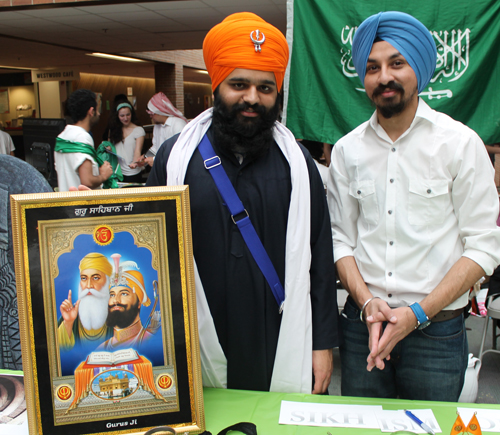
Paramjit Singh explained the Indian clothing he was wearing at the Cleveland Museum of Art's International Cleveland Community Day in the Atrium of the museum. Paramjit is a Sikh and explained about the turban too.
2014
Asian Heritage Day Celebration
Cleveland City Hall Rotunda
May 28, 2014 The City of Cleveland Community Relations Board, led by Asian Liaison Chia-Min Chen, hosted an Asian Heritage Day Celebration on May 28, 2014 in the Cleveland City Hall Rotunda.
Over 60 Asian community groups and organizations participated. Chia-Min Chen called them up to the stage one at a time and each gave an elevator speech explaining their organization.
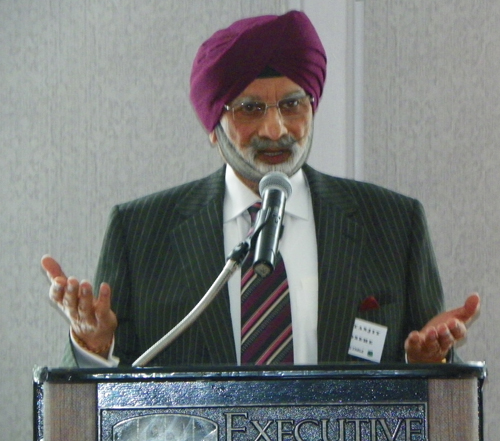
This included the Cleveland Coalition for Peace and Non Violence led by Paramjit Singh who told the crowd that Sikhism is the 5th largest religion in the world.
Paramjit Singh
Learn more about each organization including photos and videos of the group leaders at the Asian Organizations in Cleveland pages.
2013
Why and when Indians (and Sikhs) came to Cleveland
Mona Alag, past president of the Federation of India Community Associations (FICA) in Cleveland Ohio spoke at the Cleveland Food Adventurers event at the Saffron Patch. Mona was asked why and when Indians came to the US and to Cleveland.
She asked Shiv Aggarwal to answer and he said many came around 1962 and 1963. Paramjit Singh told why and when many Sikhs came here.
Members of the Food Passport program visit different authentic ethnic restaurant and learn about the cuisine and culture.
Ratanjit S. Sondhe inducted into the Cleveland International Hall of Fame
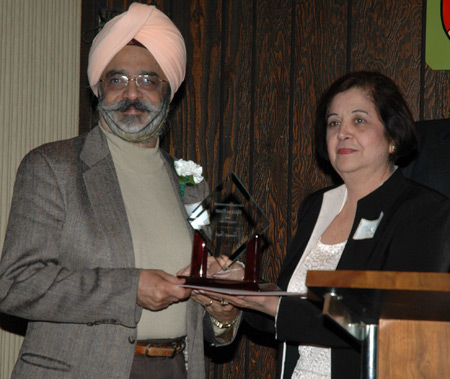
Ratanjit Sondhe was inducted into the Cleveland International Hall of Fame in a ceremony on Wednesday May 8, 2013. Ratanjit was inducted by Ken Lanci, Chairman and CEO of Consolidated Graphics Group. The honorees were inducted at a sold-out (over 430) dinner ceremony in the Grand Ballroom of the Marriott at Key Center.
Ratanjit Sondhe
Ratanjit is the second Sikh to be inducted into the Cleveland International Hall of Fame following Paramjit Singh's 2010 induction.
The Cleveland Sikh community was represented at the 2013 Culture Shock event which was put on by Cuyahoga Community College (Tri-C) West and the Parma City School District.
Church Women United in Greater Cleveland is a group of women who gather together to promote the positive similarities of our faiths and accentuate the underlying oneness of the various religious groups and affiliations. This year's theme was "The Myths And Mysteries In Our Religions" and featured speakers from the following faiths: Catholic, Jewish, Lutheran, Muslim and Sikh.
Ratanjit Sondhe of the Guru Nanak Foundation spoke about the Sikh faith
Ratanjit Sondhe told of the complete equality of women and men in the Sikh faith. He said that the civility of a society is measured by how educated and respected their women are.
2012
Our condolences to the family and friends of the victims of the senseless Milwaukee tragedy.
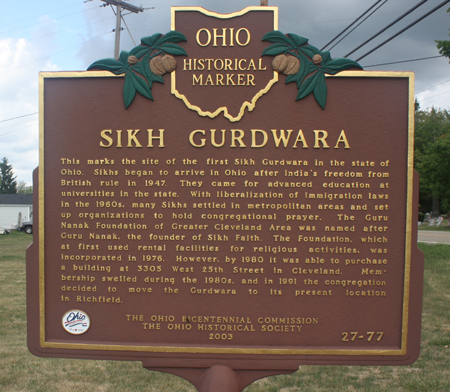
About 700 members of the Sikh and non-Sikh communities gathered on Sunday August 12 at the Richfield Ohio Sikh Gurdwara for a special service to unite the community and show support for the victims of this senseless tragedy.
Politicians and Sikh and other religious and community organizations leaders spoke. See photos and videos from the event as listed below.
Several other local vigils were also held. Two vigils on Wednesday, August 8 at the Bedford and Richfield Gurdwaras and one on Saturday evening August 11 at the Bedford Gurdwara. Wednesday August 12 at 6:00pm at the Free Stamp in Willard Park organized by the Federation of India Community Associations (FICA).
The Sikh Community of Greater Cleveland reports that they are "touched by the overwhelming support by the community at large."
Serving Humanity is one of the pillars of the Sikh faith. Paramjit Singh and other volunteers of Project Seva have been serving the community in Cleveland for years. For example, Project Seva has been working with St. Colman's Church at West 65th and Lorain since 1999. Last year, Project Seva served over 125,000 pounds of food in 3 churches and the American Indian Education Center.
During the Christmas season, the Project Seva dinner at St Colman's Church took on a holiday flavor. Watch as Paramjit Singh explains Project Seva's role in the Christmas celebration.
Cleveland the City of Peace and Nonviolence (CCPNV) is a coalition of individuals, families,organizations and religious institutions in the Greater Cleveland area that seeks to explore, practice and promote Mahatma Gandhi's and Dr. Martin Luther King Jr.'s philosophy of using nonviolence for righting wrongs and establishing a culture of humanity, justice, peace and nonviolence for the prosperity of the area.
Paramjit Singh has been working his entire life to bring these ideals to his adopted home city. He created the Cyber Wall of Peace whereby people can pledge to Treat others the way you would like to be treated, Stand against hate, injustice and intolerance and similar ideals. If you agree, please sign the pledge.
The world's first dedicated Sikh memorial is being planned
Ed Hill of the Derby Telegraph reports, "The world's first dedicated Sikh memorial is being planned in Derby to represent millions of Sikhs who died in six holocausts and both world wars.
Planning permission is being sought to create the National Sikh Holocaust and Shaheedi Memorial in Pear Tree.
The Sikh community said it would be "unique" and the first of its kind worldwide.
Gurmel Singh Kandola, one of the volunteers who
set up the National Sikh Heritage Centre, in Prince's Street, said funding would come entirely from donations from the Sikh community. He said: "This memorial is going to have a lot of interest from around the world. It will be really high-profile.
"We hope a member of the Royal family will formally open it later this year."
The memorial, 7.2 metres high and 13 metres wide, would be made from granite and sandstone and built close to the heritage centre, where a museum dedicated to Sikh culture opened two years ago. It would highlight the huge contribution of Sikhs to the UK Sikhs who died in the world wars and a further 109,000 were injured.
And it would be a place to remember the millions who died in six holocausts in India and Pakistan between 1658 and 1995.
The project has been welcomed by Gurmel Singh Bola, whose uncle, Chatter Singh, was killed in 1984 during the most recent holocaust. The 50-year-old, of Heatherton village, said: "My uncle was shot by a policeman and then a mob starting beating him with metal rods and set fire to him.
"I think this memorial is a very nice idea, especially as there are war memorials around the country but nothing like this."
The memorial, if given permission, would be made of white stone, white granite, black granite and sandstone. People would enter through an ornate archway and
there would be eight steps up to a water feature, with seats lined up on either side for people to sit.
Last year, then Prime Minister Gordon Brown visited the heritage centre, which focuses on the Sikh story. Mr Singh Kandola said: "We are a community which
hasn't healed. The Jewish community has gone some way to heal, but we feel our story hasn't been told.
"We haven't had any closure and this is why we are having this memorial." He added that "political reasons" had prevented a memorial being built in India.
Engineering firm Morgan Tucker would design and manage the construction of the memorial from different types of stone each with a specific meaning.
Matthew Tucker, from the firm, said: "We are delighted to be working with the Sikh community on this memorial. "The combined museum and heritage centre and
memorial will put Derby on the world stage."
Full planning permission will be sought shortly. If granted, work could start on site in the
spring, said Mr Tucker, with the memorial completed later in 2011.
Frank McArdle, chief executive of South Derbyshire District Council, is patron to the
National Sikh Heritage Centre and Holocaust Museum. He said: "I am convinced that this is an excellent opportunity to promote community cohesion in and around the city of Derby.
"This will be a beacon which will help promote Derby as a destination for Sikhs from all over the world for many years to come."
Six Holocausts In Four Centuries:
1st Sikh Holocaust, 1658
Muslim Emperor Auragnzeb, on becoming the ruler of India in 1658, started a campaign to forcibly convert the entire population of India to his faith.
2nd Sikh Holocaust, 1708-1716
The Mughal Emperors Bahadur Shah and Farrukh Shah took steps to try to exterminate the Sikhs by
issuing a number of edicts instructing the population. An estimated 25,000 Sikhs died as a result.
3rd Sikh Holocaust 1726-1746
During this period bounties were placed on the heads of Sikhs. Information on the whereabouts of
a Sikh was worth 10 Rupees, a dead Sikh was worth 50 and a Sikh brought alive to the Lahore markets was worth 100.
4th Sikh Holocaust 1758-1767
Ahmed Shah Abdali invaded India from Afghanistan and despised the Sikhs who constantly harassed
his armies. For revenge, he sent an army of over 150,000 men to attack a much smaller band of Sikhs. Over 30,000 Sikhs were killed in February 1762. This event is known in Sikh history as the Wada Ghallughara, or the Great Holocaust.
5th Sikh Holocaust 1947
India was given independence from the British but the Sikhs' homeland, Panjab, was carved in two between India and the new Pakistan.
Sikhs found themselves being run out of their own homes by mobs. An estimated 40% of the Sikh population became homeless and 2.5% of the Sikh population killed.
6th Sikh Holocaust 1984-1995
Sikhs demanded resolution of their historical grievances relating to Panjab state but the
media, politicians, police, army and extremist organisations were used to silence them. In total about 200,000 Sikhs died.
Paramjit Singh named to Inaugural Class of Cleveland International Hall of Fame.
Paramjit Singh first came to Cleveland in 1962 and has been helping the local community since then. Mr. Singh joined a stellar cast of inductees in the inaugural class of the Cleveland International Hall of Fame.
FICA President Mona Alag inducted Paramjit Singh
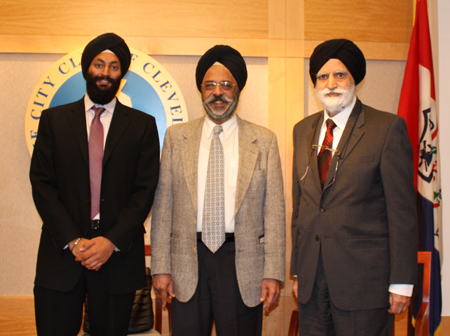
Jasjit Singh, Paramjit Singh and Dr. I.J. Singh spoke at the Cleveland City Club
The core philosophy of the Sikh religion can be understood in the beginning hymn of the holy Guru Granth Sahib
"There is one supreme eternal reality; the truth; imminent in all things; creator of all things; immanent in creation. Without fear and without hatred; not subject to time; beyond birth and death; self-revealing. Known by the Guru’s grace."
Guru Nanak, the founder of the faith, summed up the basis of Sikh lifestyle in three requirements: Naam Japo, Kirat Karni and Wand kay Shako, which means meditate on the holy name (Waheguru), work diligently and honestly, and share one's fruits.
Read more about the Sikh and other Ambassadors. If you are interested in being considered to be an official ClevelandPeople.com Ambassador to the Cleveland Sikh community, please contact us.