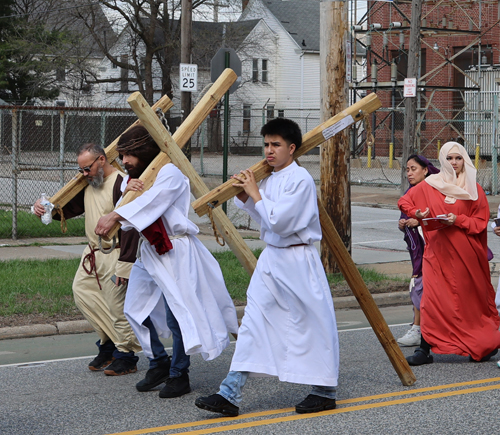
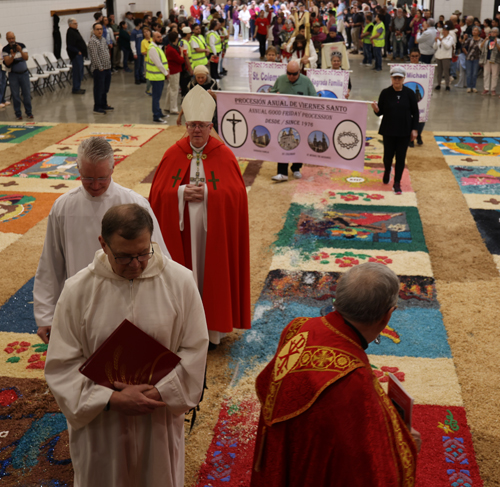
A Good Friday Procession covered 3 churches in Cleveland on Good Friday 2026. It began at La Sagrada Familia Church at 7719 Detroit Ave. on Cleveland's West Side. The procession included Bishop Michael Woost, other priests, a man dressed as Jesus carrying a cross, Roman Centurions, Saint Veronica and more.
They marched through the neighborhoods to St. Colman Church where they processed in for a service. The final stop was at St. Michael the Archangel Church at Scranton and Clark in Cleveland.
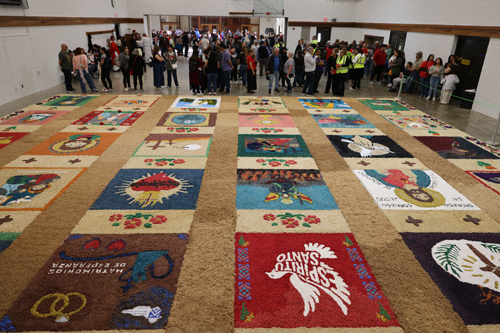
The gymnasium at La Sagrada Familia Parish which was filled with dozens of colorful, sawdust carpets, known as the Carpets of Holy Week. In Spanish, they are called Alfombras de Semana Santa. The handiwork was done by individuals, families, parish organizations, nonprofits and other groups.
This Church is home to worshippers from over 15 different Hispanic countries. The Carpets became an annual tradition in 2014 when their priest brought the custom from El Salvador. The carpets are a tradition there and in Guatemala, the Dominican Republic, Puerto Rico and other places.
Carpets of Holy Week
The Good Friday procession walks over them and then these beautiful creations are swept up. They only exist through Holy Week.
Spotting and Avoiding Scams for Hispanic and other Communities
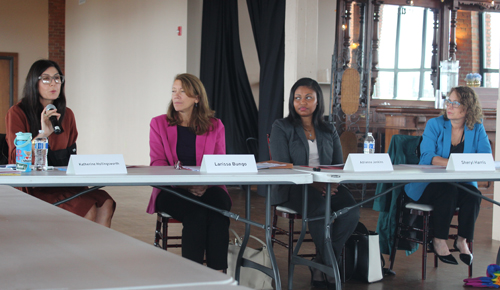
The Federal Trade Commission (FTC) is a government agency that protects people from frauds and scams. Unfortunately, scammer often target communities that they feel are vulnerable. That may be senior citizens, immigrants or members of ethnic communities. The FTC partnered with Ethnic Media Services (EMS) and hosted an event in Cleveland Ohio on September 24, 2024 dealing with Spotting and Avoiding Scams - especially for the ethnic communities.
Experts from several agencies were joined by ethnic community leaders and members of ethnic media outlets for a robust and informative session.
Speakers from the FTC, Legal Aid and Cuyahoga County at the Scam event
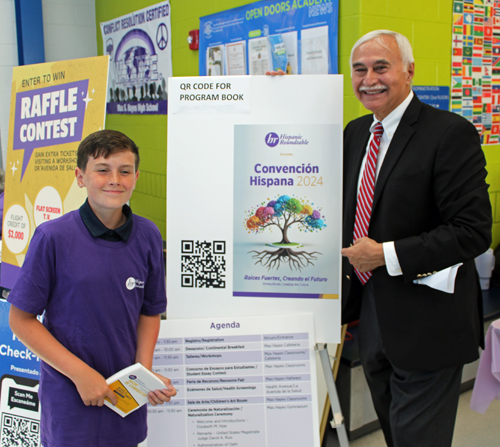
The Hispanic Roundtable hosted their 2024 community convention on Saturday September 21,2024. It featured a Naturalization Ceremony, workshops for immigration, financial and medical advice, student contests, health screenings, a resource fair and more. The keynote presentation was a conversation between HRT co-founder José C. Feliciano and EGOT (Emmy, Grammy, Oscar, Tony) winner Rita Moreno.
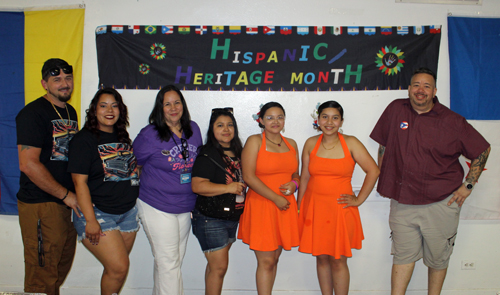
Julia De Burgos Cultural Arts Center in Cleveland Ohio was founded in 1989 as a family oriented center to serve the Latino youth and their families through programs and activities designed to foster cultural pride and art appreciation. On Saturday September 14, 2024 they celebrated their 10th annual Celebrando which is dedicated to honoring the rich cultural heritage of the Hispanic and Latino communities in Cleveland. It's a vibrant and engaging occasion filled with music, dance, and traditional cuisine, as well as educational and artistic presentations.
Doors to My Barrio at Julia de Burgos features old doors as canvases for artists to paint about the land of their heritage including Argentina, Bolivia, Costa Rica, Panama, Chile, El Salvador, Mexico, Dominican Republic, Brazil, Ecuador, Nicaragua, Peru, Guatemala, Cuba, Venezuela and more.
Cleveland was the proud host of the 2024 Pan-American Masters Games from July 12-21, 2024. A major event of the International Masters Games Association, the Games offer an opportunity to showcase competitive spirit and athletic ability of masters athletes on a global stage. Thousands of athletes from 6 continents (sorry Antarctica), 48 states and more than 70 countries, including Argentina, came to Cleveland in a celebration of health, vitality, friendship and an active lifestyle at any age.
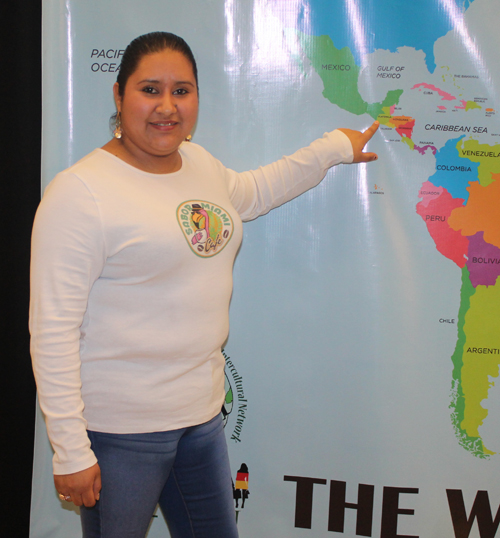
Guatemala represented at Cleveland Multicultural Holiday Celebration
The Cleveland Guatemala community was represented at the 8th Annual ICC-WIN Cleveland Multicultural Holiday Celebration on Wednesday, December 6, 2017 at the Global Center for Health Innovation in Cleveland.
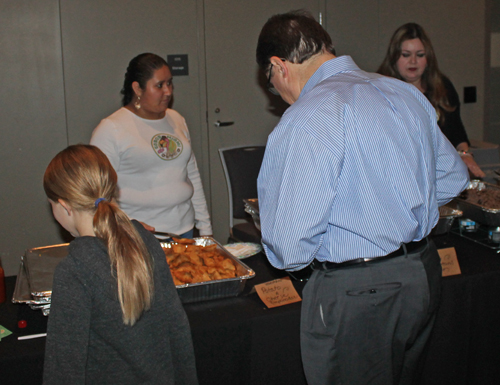
People enjoyed food from Sabor Miami Latin American Cafe.
When news of the unaccompanied children crossing the US-Mexico border was released, concerned citizens in Cleveland started meeting regularly to see how they could help. They formed the Children's Coalition and their regular meetings led to a community information night. Over 100 people attended the information session at Saigon Plaza at West 54th and Detroit to learn and speak about the Unaccompanied Children and Mothers.
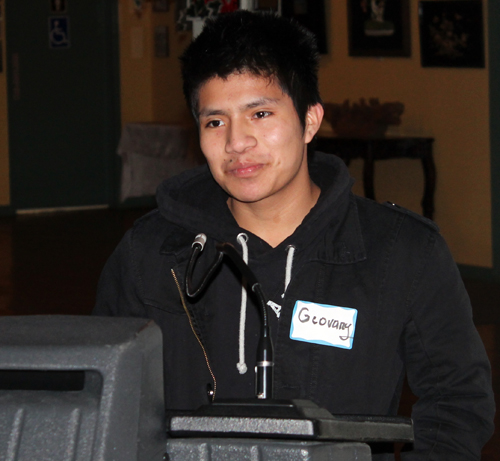
A young boy told the story of his family in Guatemala being beaten and bullied. He fears for his 13 year old sister who is still there.
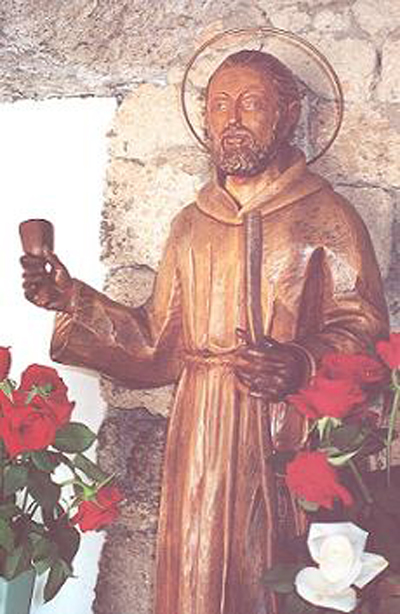
Central America claimed its first saint with the canonization of Pedro de San José Betancur. Known as the “St. Francis of the Americas,” Pedro de Betancur is the first saint to have worked and died in Guatemala.
Pedro very much wanted to become a priest, but God had other plans for the young man born into a poor family on Tenerife in the Canary Islands. Pedro was a shepherd until age 24, when he began to make his way to Guatemala, hoping to connect with a relative engaged in government service there. By the time he reached Havana, he was out of money. After working there to earn more, he got to Guatemala City the following year. When he arrived, he was so destitute that he joined the breadline that the Franciscans had established.
Soon, Pedro enrolled in the local Jesuit college in hopes of studying for the priesthood. No matter how hard he tried, however, he could not master the material; he withdrew from school. In 1655, he joined the Secular Franciscan Order. Three years later, he opened a hospital for the convalescent poor; a shelter for the homeless, and a school for the poor soon followed. Not wanting to neglect the rich of Guatemala City, Pedro began walking through their part of town ringing a bell and inviting them to repent.
Other men came to share in Pedro’s work. Out of this group came the Bethlehemite Congregation, which won papal approval after Pedro’s death. A Bethlehemite sisters’ community, similarly founded after Pedro’s death, was inspired by his life of prayer and compassion.
He is sometimes credited with originating the Christmas Eve posadas procession in which people representing Mary and Joseph seek a night’s lodging from their neighbors. The custom soon spread to Mexico and other Central American countries.
Pedro died in 1667, and was canonized by Pope John Paul II in Guatemala City on July 30, 2002.
Calling the new saint an “outstanding example” of Christian mercy, the Holy Father noted that Saint Pedro practiced mercy “heroically with the lowliest and the most deprived.” Speaking to the estimated 500,000 Guatemalans in attendance, the Holy Father spoke of the social ills that plague the country today and of the need for change.
“Let us think of the children and young people who are homeless or deprived of an education; of abandoned women with their many needs; of the hordes of social outcasts who live in the cities; of the victims of organized crime, of prostitution or of drugs; of the sick who are neglected and the elderly who live in loneliness,” he said in his homily during the three-hour liturgy.
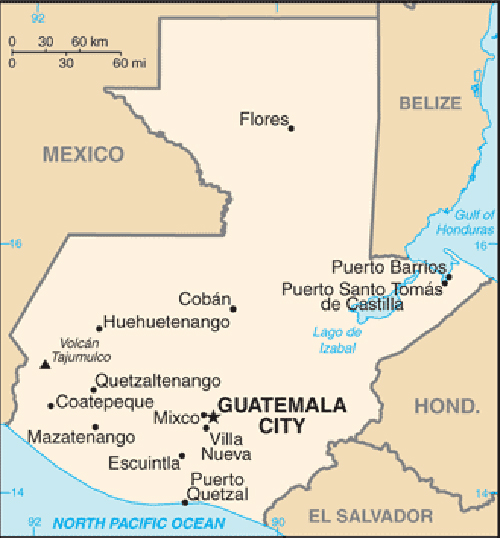
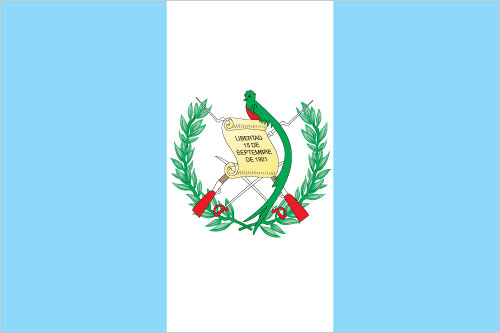
The Maya civilization flourished in Guatemala and surrounding regions during the first millennium A.D. After almost three centuries as a Spanish colony, Guatemala won its independence in 1821.
During the second half of the 20th century, it experienced a variety of military and civilian governments, as well as a 36-year guerrilla war.
In 1996, the government signed a peace agreement formally ending the internal conflict, which had left more than 200,000 people dead and had created, by some estimates, about 1 million refugees.
 >
>