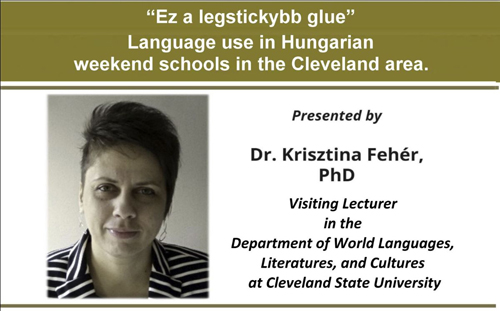
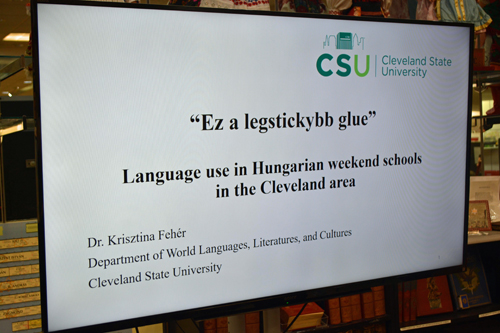
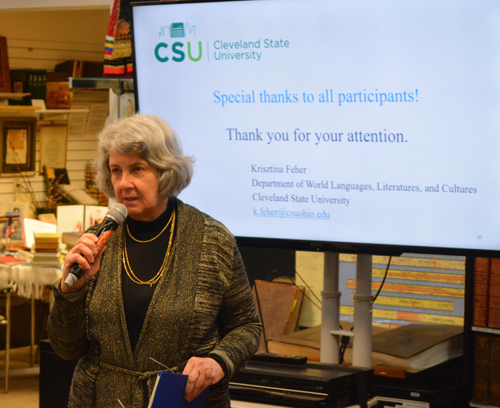
It was so good to see many leaders of the Hungarian Community hearing about the use of our ancient language in this particular diaspora. Our guest speaker and researcher was Dr. Krisztina Fehér, who was introduced by Mrs. Kuni Nádas, a member of the Lectures Series Committee. Dr. Fehér has been a visiting lecturer at Cleveland State University for the last five years. She received her doctorate in 2012 in Hungarian Linguistics and was an assistant professor at the Department of Hungarian Linguistics at the University of Debrecen. She is the author of three recent books on linguistic methodology (2016), the phonology of child language (2017), and cognitive grammar (2018) in Hungarian.
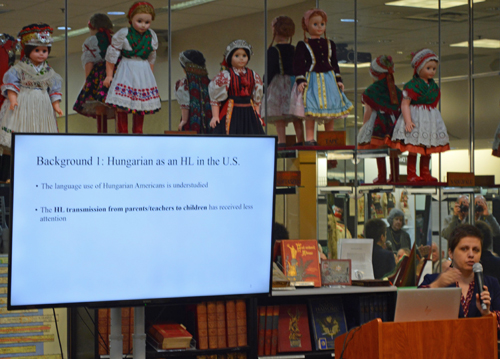
Dr. Fehér was still in Hungary in 2021 when she started research on the Cleveland area which has the largest Hungarian group in the U.S. One of the reasons she considered this study is because she felt that although there were books published on the history and culture of Hungarian groups (Papp, Szentkiralyi (2018), there weren't any on the language use itself.
Her study included those with familiarity with the Hungarian language; had Hungarian heritage and lived in the Cleveland area. They were between the ages of 6-17 or teachers in the Hungarian schools.
Her study was a complex analysis with charts and categorizations to explain her course of action and its results about the children and teachers. She did field observation, linguistic landscape study, classroom observation and background questionnaire. On the questionnaire, she had two groups. In the first group (from parents) she had 544 submissions and the second group (from students, parents and teachers) 68 participants. The first group yielded quantitative subjective data and the second qualitative objective data. She also wrote about switching and mixing in the two languages.
There was so much more information. However, these are some of her findings:
- In the teachers' group she found there was more mixing of the two languages than switching the two. There was an element of judgment in the switching.
- In the students' group, she indicated students preferred English and the switching was more common.
- Sample of Code-mixing is the phrase "Buckeye Magyar"
- Respectful forms of language disappearing
- Distinction between respectful and casual discussed
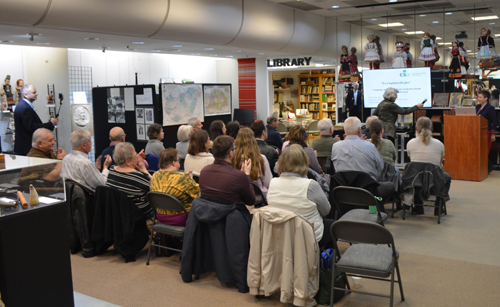
She also mentioned during the end that there exists a bi-lingual mode in the brain and that the more bi-lingual a person is the more code-mixing there is. Also mentioned, during the audience participation, was that the language of counting determines the dominant language.As always, we wish to thank those who helped bring about this presentation: The Lecture Committee members; Alex and Janos, for setting up the tables and chairs and then clearing them afterwards. The refreshments on the table were provided by Kati Gulden, Hajnal Kezdi, Elizabeth Lakatos, Mary Jane Molnar, Eva Szabo, and Elizabeth Papp-Taylor. Barb and Janos Szigeti load and clear the liquid refreshments' table and clean the kitchen afterwards. Alex sat by the donation table and greeted guests. Miklos Szentkiralyi took these pictures below and Mary Jane Molnar worked at the Gift Shop. And now we know more about how we use our language and some of the understanding behind it.
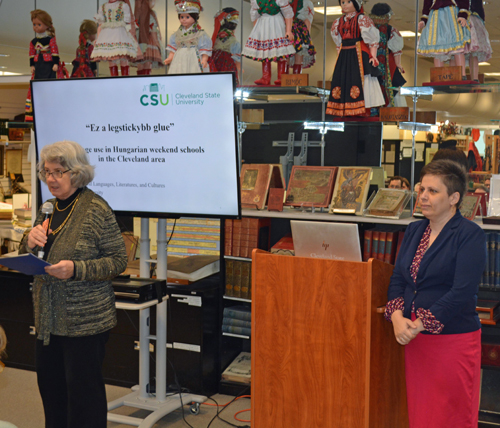
Kuni Nadas introduces Dr. Krisztina Feher
*** Want to learn about ethnic and cultural events like Liszt in the Hungarian Cultural Garden? Sign up for the free eNews and every Tuesday evening you will receive a free e-mail listing the next week's events. It's easy and free.
Fill out the form for the free weekly eNews.***
Back to Cleveland Hungarians
|