Perhaps the most striking statue in Cleveland's Cultural Gardens, our city's monument to its diversity, is that of an anonymous immigrant mother holding two children. It can be found in the lower level of the Croatian Garden. It challenges our concept of who should be honored in the history of our multicultural city. 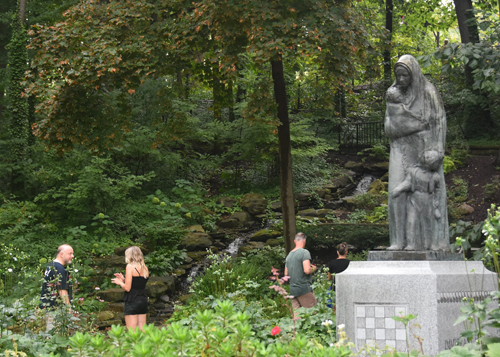 Immigrant Mother statue in Croatian Cultural Garden Immigrant Mother statue in Croatian Cultural Garden
Certainly, there are other women, all famous, depicted within the Gardens, but no other monument binds us together as well as this - it is a reminder that migration and immigration are not simply the stories of famous men, nor is the history of women simply that of those whom we choose to see as agents of change. Each of us may well have a story such as the one that follows.
In 1906 Antonia Bohinc and John Vuk, her new husband left their home in what is now Slovenia to come to Cleveland. There they would join Michael, her brother-in-law. She was nineteen, the daughter of a charcoal burner from the town Kropa. John, likely an orphan, was from the nearby settlement of Kamna Gorica. John left little behind while Antonia left behind her parents and two brothers.
Kropa was a smokey town of iron forges, forges that created the spikes that helped build Venice. But it was nestled in a green semi-rural, hilly area of the countryside. Today it is a stunning small village, almost frozen in time.
Antonia's life in Cleveland would be far different. The couple settled on Lakecourt, a small street of small frame homes running a short distance westward from E. 55th Street just north of the Lake Shore & Michigan railroad tracks. She may have enjoyed the view of the lake to the north, but it was compromised by the continual din of trains and the coal smoke that they and the area factories, such as the one that John worked in, emitted. It was likely a wrenching change of scenery. And there she settled into the life expected of her at that time - cooking, keeping house, and having children.
She had her first child, Kate, in 1907; two years later a second child, Marie was born; followed in 1911 by Antonia (known as Rose) and in 1913, a fourth daughter, Frances. It was literally one pregnancy after another, each in a new world, and strange surroundings. One of her daughters recalled a bit of family lore that each of them had been delivered in the house by the tracks.
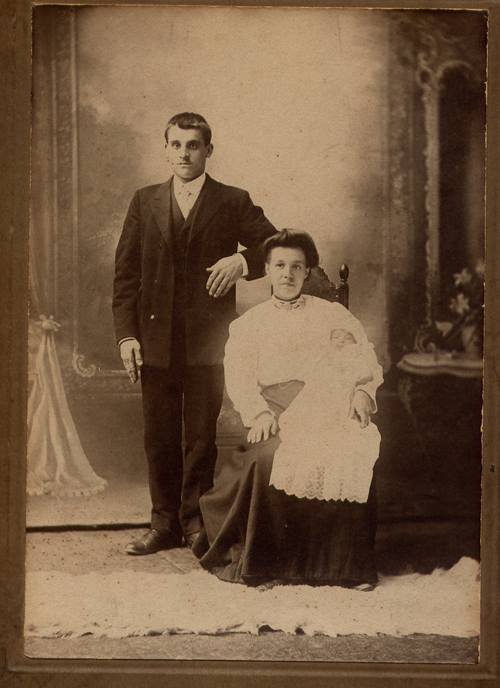 John and Antonia Vuk and their first daughter Kate
In slightly less than nine years after arriving in Cleveland she would come down with a common affliction in crowded American cities. She died of tuberculosis in the Cleveland City Hospital on May 24th of that year. Her husband spent an enormous sum of $72.50 on her funeral, the equivalent to over $1,800 today. He could not fully pay the bill. Her grave in Calvary Cemetery lacked a proper stone until one of her daughters, Marie, purchased one many years later. Nor could he care for his young daughters. One was sent to live with a friend, the two youngest spent some time in a Catholic orphanage. Eventually he would remarry.
Each of the four daughters would survive far longer than their mother, but only one would have children - ironically, two boys. Each would carry part of the family heritage with them and one, rebellious in her own way, would be tempted to become a chorus girl, and then train as a cosmetologist, only to later be prohibited by her husband to practice her trade as he, the son of immigrants, insisted in being the breadwinner.
This story of one young immigrant woman, who brought four daughters into the world and then died at the age of 28 is tragic, but not unique. Nor are the lives of her daughters. Similar stories can be found throughout the world, both then and, indeed, now. Yet, in and of itself, it indicates that in our celebration of Women's History Month, our focus need not only be on those who have achieved a solid place in the history books, but on every woman. It is, perhaps, the story of "every woman" that most truly resonates with our own experiences and best allows us to see our shared humanity.
Note: John Grabowski originally wrote this for Mothers Day. He says, "The wannabe 'Chorus Girl' was my mother. She was one heck of a person."
Top of Page
Back to Cleveland Slovenians
|